
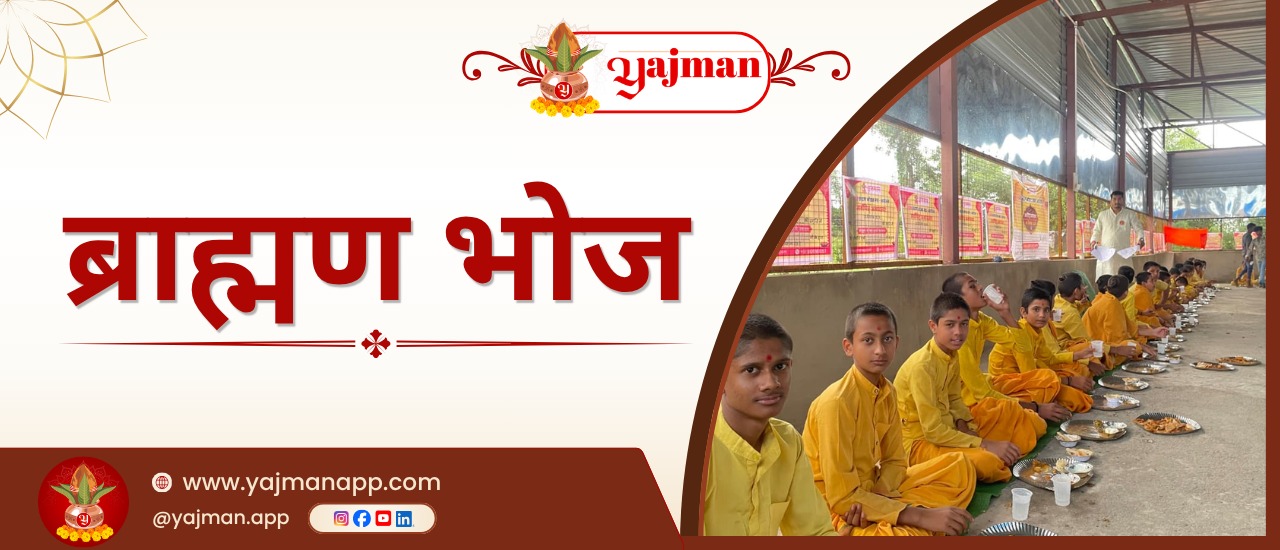
Why Is Brahmin Bhoj So Important During Prita Paksha Shraddha?
When families begin preparing for Shraddha during Prita Paksha, most conversations quickly turn to Tarpan and Pind Daan, the water and rice ball offerings made in memory of ancestors. Far fewer people ask about the third and equally essential part of the ritual, Brahmin Bhoj, the act of feeding qualified Brahmins as part of the ceremony. Yet without it, tradition holds that the entire ritual remains incomplete.
Brahmin Bhoj is considered so important during Prita Paksha Shraddha because it is regarded as one of the three essential pillars of the ceremony, alongside Tarpan and Pind Daan and classical texts such as the Manu Smriti describe a Shraddha performed without it as incomplete. The belief is that feeding a qualified Brahmin, with the ancestor's name invoked through proper mantras, allows the offering to spiritually reach the ancestors residing in Prita Loka. Without this final step, the water and rice offerings alone are not considered sufficient to fully honour and satisfy the departed souls.
What Brahmin Bhoj Means and Where It Fits Within Shraddha
Shraddha is the ritual performed with faith and devotion to nourish and honour one's ancestors, and it traditionally rests on 3 interconnected pillars. Understanding how these three pillars work together makes it much easier to see why Brahmin Bhoj cannot simply be skipped or treated as optional.
Tarpan is the offering of water, usually mixed with sesame seeds, made to the ancestors as a symbol of nourishment and remembrance.
Pind Daan is the offering of rice balls, often prepared with rice, barley, and ghee, symbolically representing a subtle body for the ancestor and offered with prayers for their liberation.
Brahmin Bhoj is the feeding of qualified Brahmins, who receive the offering on behalf of the ancestors or deities being honoured during the ceremony.
Each of these three elements is understood to nourish a different dimension of the ancestor's existence. If Pind Daan is thought to nourish the physical-subtle dimension and Tarpan nourishes the energetic dimension, Brahmin Bhoj is understood to nourish the dimension of grace, acting as the channel through which the family's devotion is carried forward and completed.
Why Shraddha Is Considered Incomplete Without Brahmin Bhoj
This is not a minor or regional custom. The Manu Smriti, one of the most authoritative texts on Hindu ritual conduct, states that a Shraddha performed without Brahmin Bhoj does not fully reach the ancestors. This teaching has been repeated consistently across generations of scriptural interpretation, which is why priests and purohits across different regions of India continue to treat Brahmin Bhoj as non-negotiable rather than an optional add-on to the ceremony.
The Scriptural Basis for Feeding Brahmins
Beyond the Manu Smriti's instruction that Brahmin Bhoj is required, the Garuda Purana goes further in explaining why this specific act carries such spiritual weight. According to the Garuda Purana, “Brahmins who have devoted themselves to Vedic learning and who maintain purity in thought, word and action are believed to carry a particular spiritual quality that allows the food offered to them to be transformed into a subtle offering suited for the ancestors.”
In practical terms, this means that when a Brahmin is seated and served with the appropriate mantras, including the specific naming of the ancestor being honoured during the sankalp, the food offered is understood to be elevated beyond an ordinary meal. The Garuda Purana describes the satisfaction of the Brahmin as generating a subtle energy that is able to cross the boundary between the earthly realm and the realm where the ancestors reside, which is why the act of feeding is treated as spiritually equivalent to directly nourishing the departed souls themselves.
Why Brahmins Are Understood to Represent the Ancestors
This belief is closely tied to the broader idea, found across Hindu tradition, that a qualified Brahmin acts as a medium or channel during ritual worship. Just as Brahmins are honoured during pujas as representatives through whom offerings reach the divine, during Shraddha they are understood to serve the same function in reverse, carrying the family's devotion and offering toward the ancestors rather than toward a deity. This is part of why feeding a Brahmin during Shraddha is often described in scripture as being equivalent to feeding the ancestors directly.
The Concept of Prita Loka and Why Timing Matters
To fully understand why this ritual carries such urgency specifically during Prita Paksha, it helps to understand where Hindu tradition believes ancestors actually reside. According to Hindu belief, the souls of three preceding generations of one's ancestors reside in Prita Loka, a realm situated between heaven and earth, governed by Yama, the god of death, who is understood to guide departed souls from the earthly realm into this intermediate realm.
Prita Paksha refers to a sixteen day period in the Hindu lunar month of Bhadrapada, which typically falls in September, beginning at the point when the sun enters the zodiac sign of Virgo. According to tradition, this is the specific window during which the ancestral souls are believed to leave Prita Loka and descend closer to their descendants, remaining present until the sun moves into the next zodiac sign and the period concludes on Sarvapitri Amavasya, the new moon day that marks the end of the fortnight.
This is precisely why Shraddha rituals, including Brahmin Bhoj, are considered to carry exceptional significance specifically during these sixteen days, rather than being treated as equally meaningful at any other point in the year. Offerings made during this window are believed to reach the ancestors far more directly, since they are understood to be present and receptive during exactly this period.
The Traditional Story of Karna
One of the most widely referenced explanations for why this specific fortnight continues to be observed comes from the Mahabharata, through the story of Karna. According to the traditional narrative, Karna was known throughout his life for his extraordinary generosity, giving away gold and wealth freely to anyone who asked. However, because he had grown up unaware of his true lineage, he never offered food or water in the name of his ancestors during his lifetime.
After his death, when Karna reached the heavenly realm, he was offered gold rather than food as part of his due reward. When he asked why he had received gold instead of nourishment, he was told that this reflected the exact nature of the charity he had given during his life, generous in wealth but empty of offerings made specifically to sustain his ancestors. Given a brief period to return to the earthly realm and correct this, Karna is said to have used those sixteen days to feed Brahmins and the poor and to offer water in the name of his forefathers. This period is traditionally identified as the origin of what is now observed each year as Prita Paksha, and the story continues to be told specifically to illustrate why feeding others, and Brahmins in particular, matters just as much as any other form of charity or devotion.
Brahmin Bhoj and the Alleviation of Prita Dosha
Scriptural and traditional belief also connects Brahmin Bhoj directly to the concept of Prita Dosha, a condition believed to arise when a family's ancestors remain unsatisfied or unhonoured, whether due to an improperly performed Shraddha, a forgotten death anniversary, or the simple passage of time without proper remembrance. Prita Dosha is traditionally understood to affect the wellbeing, harmony, and prosperity of the living descendants of that family.
Performing a complete Shraddha with proper Brahmin Bhoj during Prita Paksha is widely described in tradition as one of the primary remedies for Prita Dosha, alongside Tarpan and Pind Daan. Families who have been unable to identify the exact death anniversary of a particular ancestor, or who wish to make amends for a ritual that may have been missed or performed incompletely in the past, are often advised to perform Shraddha specifically on Sarvapitri Amavasya, the final day of Prita Paksha, since this day is considered suitable for honouring all ancestors collectively, regardless of their individual death dates.
How Brahmin Bhoj Is Properly Performed Today
While regional customs vary slightly, the core structure of Brahmin Bhoj during Shraddha has remained largely consistent across generations.
A qualified Brahmin or purohit is invited, ideally someone known for their Vedic learning and disciplined conduct, since this is believed to directly affect the spiritual value of the offering.
The sankalp, a formal statement of intent, is recited, specifically naming the ancestor in whose honour the ritual is being performed.
A pure, satvik meal is prepared and served with respect, often including the ancestor's favourite foods where known and remembered.
Alongside the meal, dakshina, clothing and other gifts are typically offered to the Brahmin as a further gesture of honour and gratitude.
The family seeks the Brahmin's blessings at the conclusion of the meal, which are understood to carry forward the spiritual benefit of the entire ceremony.
Because the sankalp, the mantras, and the sequencing of the ritual all matter to how effectively the ceremony is believed to reach the ancestors, many families prefer to have an experienced and properly trained purohit guide the entire process rather than attempting it without guidance. Families who want their Prita Paksha Shraddha, including a correctly performed Brahmin Bhoj, conducted with full authenticity can book a verified purohit through Yajman App, which connects devotees with experienced priests who can guide the sankalp, the Tarpan, the Pind Daan, and the Brahmin Bhoj according to proper tradition.
Honouring Ancestors Through a Complete Ritual
Brahmin Bhoj is far more than a meal shared as part of a religious occasion. Within the framework of Shraddha, it represents the final and completing act of a ritual built around remembrance, gratitude, and continuity between generations. Where Tarpan and Pind Daan nourish the ancestor directly, Brahmin Bhoj is understood to carry that devotion forward through grace, ensuring that the family's efforts are not only offered but genuinely received.
For families observing Prita Paksha, understanding why this specific act carries such weight often deepens the meaning of the entire ceremony. It transforms Brahmin Bhoj from a ritual formality into what it has always been understood to be, a sincere and complete act of honouring those who came before.
Frequently Asked Questions (FAQs)
Why do we feed Brahmins during Prita Paksha?
Feeding Brahmins during Prita Paksha is believed to spiritually nourish one's ancestors, since qualified Brahmins are understood to act as a channel through which the offering reaches Prita Loka. Classical texts describe this as an essential part of a complete Shraddha ceremony.
What is the importance of Brahmin Bhoj in Shraddha rituals?
Brahmin Bhoj is one of the three essential pillars of Shraddha, alongside Tarpan and Pind Daan. The Manu Smriti states that a Shraddha performed without Brahmin Bhoj is considered incomplete and does not fully reach the ancestors being honoured.
Why is feeding Brahmins considered equal to feeding ancestors?
According to the Garuda Purana, learned and disciplined Brahmins carry a spiritual purity that transforms the food offered to them into a subtle offering that reaches the ancestors in Prita Loka, making the act spiritually equivalent to directly nourishing the departed souls.
What happens if Shraddha is done without Brahmin Bhoj?
Scripture describes such a Shraddha as incomplete, meaning the offerings of Tarpan and Pind Daan alone are not considered sufficient to fully satisfy the ancestors. Brahmin Bhoj is regarded as the completing step that carries the ritual's benefit forward.
Why is Brahmin Bhoj especially significant during Prita Paksha?
During Prita Paksha, ancestral souls are believed to descend from Prita Loka and remain close to their descendants for sixteen days. Offerings made during this specific window, including Brahmin Bhoj, are believed to reach the ancestors far more directly than at other times.
What is the story of Karna and its connection to Prita Paksha?
According to the Mahabharata, Karna gave generously in life but never offered food to his ancestors, since he did not know his true lineage. After death, he was given a brief period to return to earth and feed Brahmins and the poor, a period now observed as Prita Paksha.
How does Brahmin Bhoj help with Prita Dosha?
Prita Dosha is believed to arise when ancestors remain unsatisfied or unhonoured. Performing a complete Shraddha with proper Brahmin Bhoj during Prita Paksha is traditionally considered one of the primary remedies for alleviating Prita Dosha and restoring harmony to the family.
How is Brahmin Bhoj properly performed during Shraddha?
A qualified Brahmin is invited and served a pure, satvik meal after a sankalp naming the ancestor is recited. Dakshina and gifts are typically offered alongside the meal, followed by seeking the Brahmin's blessings to complete the ritual.